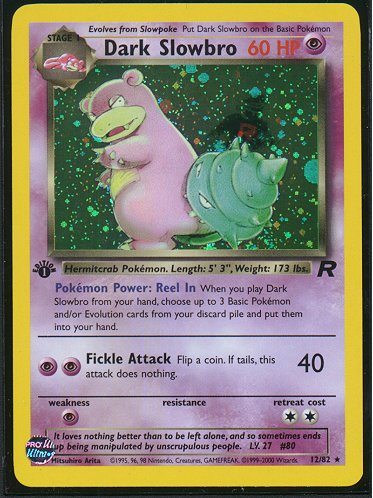
Welcome back to this blog's ongoing mission to assign a letter grade to every existing Pocket Monster. To anyone who thought I had gotten bored with this feature and abandoned it, I regret to inform you that you just lost your office pool. In this segment, we take it fast and slow, and set our feet on a sturdy rock.
071. Victreebel Best Name: Utsubot (Japanese) Type: Grass/Poison Last time, Bellsprout ably demonstrated why its name maybe should be initialed a certain way. If you get my drift. So it's a relief today to see that it made good in the end. You earned your Victree, 'Bel. James had one in the anime—in fact, he had two, and at least one liked to show affection by putting James's entire head in its mouth. I find that amusing, giving such a lovey-dovey nature to a Pokémon that typically dissolves its prey with acid to digest it a la Brundlefly. Hey, what do you call a tiny Victreebel? A Babybel. Sorry, that joke was really cheesy. OH GOD I CAN'T TURN IT OFF B+
072. Tentacool Best Name: English Type: Water/Poison My brain is just a Tentacool in the ocean of my head 'Cause I played too much Pokémon And I woke up seein' red (and blue) And now all I really want from life is to make Team Rocket dead, on account that, My brain is just a Tentacool in the ocean of my head[1] The Zubat of the sea. Pikachu, ready to do some dynamite fishing? (C-)
073. Tentacruel Best Name: Tentoxa (German) Type: Water/Poison Ditching the Brainiac dome was a smart move. I'm still roasting your face with a lightning bolt, though. C+
074. Geodude Best Name: Racaillou (French) Type: Rock/Ground I'm not about to go back and check, but I'm fairly certain we're on the first Pokémon (in numerical order) modeled after an inanimate object and not an animal or other organism. Hooray! We'll see this particular category go off the rails later, but a rock is a good place to start. Rock makes for a sturdy, unwavering foundation, and who's a sturdier friend and ally than Geodude? I bet you can't even think about it without imagining it saying its own name in the anime, in that unforgettable monotone rasp. Even its ubiquity in Mt. Moon isn't a strike against it, because Geodude is someone you want on your team. Well, not so much for Misty, but it'll give Lt. Surge what-for, I can tell you that. A-
075. Graveler Best Name: Gravalanch (French) Type: Rock/Ground Is it odd that I think Graveler looks weaker than Geodude? Something about his texture. He looks made out of papier-mâché, like a big rock piñata. It bears out in the name too—"Graveler". When you want rocks for power, you're not looking for gravel. At the very least, I want something that meets the C.W. McCall standard. C
076. Golem Best Name: Geowaz (German) Type: Rock/Ground Another real-world name, sad face. Strangely, even though golems are usually composed entirely of rock and clay, this is the only 'mon in the Geodude line with carbon-based external body parts. I understand that mythological creatures and their depictions are open to interpretation, but there are some real liberties being taken here. Every time I've ever seen it in action, Golem has had the thankless job of blowing itself up to take an opponent down with it. Has anyone ever told Golem it can have its KO cake and eat it too? Incidentally, if you've never read The Golem and the Jinni by Helene Wecker, that's an oversight you need to rectify immediately. C-
077. Ponyta Best Name: Basically the same everywhere. Type: Fire Okay. So I can understand Grimer running around the abandoned Pokémon Mansion. There's no upkeep happening, the place rots, gets moldy, etc., and that decay and mold and grossness all manifest as this poisonous blob thing. I'm with you so far. But letting wild horses overrun the place? That's way beyond any forgivable measure of irresponsibility. Whoever owns the lease on that joint needs a stern brow-beating. I can't hold that against Ponyta, of course, but what I can dock it for is showing up too late in the game to be a viable fire option. Bonus points for being a clever play on "bonita" (Spanish for "pretty"). B-
078. Rapidash Best Name: English Type: Fire Once upon a time there was a Nintendo 64 game called Pokémon Snap. You rode on a rail in a protective vehicle and took pictures of Pokémon in the wild. It was way more fun than it had any right to be. It was a good game for my FWAHTCCSECTHHTPG[2] to own, because each Pokémon had a score that was based on how well you photographed it, and since anyone could contribute a high score, it wound up being a nice communal experience. Anyway, on this friend's copy, one of our mutual friends had the high score for Rapidash, and she told us all do whatever you want, but don't touch Rapidash, that one is mine. Long story short, I touched it, and to this day, if I immerse myself in the memory, I can still feel where she punched my arm. B-
079. Slowpoke Best Name: Flegmon (German) Type: Water/Psychic One might be tempted to draw a throughline from Psyduck to Slowpoke, on account of the fact that they're both slow-witted (or at least appear as such). But Psyduck put forth genuine effort. He held his head in his hands, quacked aloud his insecurities, and lived a life mired in question marks. Slowpoke just sits there. That's why he gets that name. He's got more in common with Abra, though the latter can at least teleport away from danger. Slowpoke is the turkey that drowns from staring up at the rain, the lobster at the center of the question "does it feel pain when you boil it". Truly, it is the village idiot of Pokémon, an argument supported best by the fact that according to the Pokédex, it is known as the "Dopey Pokémon". C
080. Slowbro Best Name: Lahmus (German) Type: Water/Psychic Slowbro definitely bros like a bro. That might not make any sense, but it feels correct. Sometimes it's portrayed in artwork with a Kubrick glare that I find distinctly unsettling. I don't know what you and that conch shell are planning, but I don't like it, y'hear? When I hear or say or think "Slowbro", my mind goes to the dude in "Yertle the Turtle" by the Red Hot Chili Peppers who goes "look at that turtle go, bro". I never read Scar Tissue but I recall hearing Anthony Kiedis or someone say that that guy was their coke dealer, and they gave him a part in the song so that basically he wouldn't break their kneecaps. I really hope that's true but I've already got a sizable reading queue and music memoirs don't really figure into it right now. I'm not a big fan of the 80s, despite the fact that they earn huge bonus points for me being born in them, but you can't entirely write off any decade that gave us a George Clinton-produced funk band rap-rocking about Dr. Seuss books. B- Next time: Magnemite to Shellder ___________________________________________________ ¯¯¯¯¯¯¯¯¯¯¯¯¯¯¯¯¯¯¯¯¯¯¯¯¯¯¯¯¯¯¯¯¯¯¯¯¯¯¯¯¯¯¯¯¯¯¯¯¯¯¯ [1] One (1) internet cookie to anyone who knows what I'm spoofing here. [2] That would be "Friend Who Always Had The Current Consoles So Everyone Came To His House To Play Games".
Time for another installment of 8GR8, the feature that takes eight awesome pieces of video game music that tie around a certain theme and put them together in list form. This time, we're looking exclusively at one game: Seiken Densetsu 3, the excellent sequel to Secret of Mana that never got released (officially, anyway) outside Japan. Normally, in 8GR8, we look at a wide array of different games. But sometimes, it's fun and also timely to narrow the focus. Not only are we examining a single game today, but we're also looking at more songs from it—twelve, to be exact, rather than the usual eight. The game on the docket is Seiken Densetsu 3, an adventure in all ways superior not only to its predecessor, Secret of Mana, but to many (if not all) of the games in the series that came after it as well. Seiken Densetsu 3 claims the honor of being my favorite JRPG of all time, and the 20th anniversary of its release falls on September 30, and so there's no better time to take a look at its excellent soundtrack, composed entirely, like Secret of Mana, by Hiroki Kikuta. 1. "Little Sweet Café"
Kicking off with one of the town themes, probably the most relaxed one. There's a moment in games of this scope where you realize you're inhabiting a quaint little pocket of peace before some universe-bending stuff goes down, and it's tempting to want to stay in that pocket. And technically, you can—I mean, it's not like there's ever a time limit in these games, despite the pressing issues at hand. Sometimes, it even prevents me from finishing games. You could probably pipe this into a Starbucks and no one would bat an eyelash. Actually, how about you go save the universe? I'll just sit here nursing this venti caramel frappuccino. 2. "Nuclear Fusion"
I'll admit that Seiken Densetsu 3's oddball sound design is an acquired taste. The drums resemble nothing so much as a Street Fighter punch connecting with an opponent's jaw, and intense melee combat often sounds like jelly monsters having a slapfight. But if you can get past the former, you'll find it gives a huge adrenaline boost to many of the soundtrack's drum-heavy songs. This is one track I think benefits greatly from it, and it contains a callback to "Meridian Dance" from Secret of Mana to boot. 3. "Splash Hop"
Following the "bigger is better" credo, Seiken Densetsu 3 features not one travel buddy animal, but two. Flammie the white dragon shows up later in the game, but before he arrives, you get Booskaboo, a turtle in a snorkel summoned at certain shores by the Pihyara Flute. Booskaboo is a laid-back kind of guy, and his theme, a loping reggae tune, reflects that well. Back in the 90s, you couldn't swing a cat by the tail without hitting a VGM track with steel drums in it, but I love the bouncy breakdown featuring them here, as well as the effusive followup phrase that ends the loop. Few tracks in the game are as whistle-able as this one. 4. "Harvest November"
"Sultry" isn't generally a word that comes to mind when considering desert themes, except when playing this (and possibly a Shantae game). The heat of Navarre isn't of the oppressive variety. As deserts go, it's actually a pretty relaxing, pleasant, and fertile place. (The game saves its scary licks for the Valley of Flames, nestled deep within the desert.) 5. "Different Road"
The theme that plays while traveling the Path to the Heavens, a series of winding caves and rock bridges that culminates in both the meeting of Flammie and a view that by Super Nintendo standards is absolutely breathtaking. I like that Kikuta managed to bake such a sense of urgency into an otherwise steady-tempo'd track; it comes early in the adventure, but there are still things to be done, a world to save, and no time to waste. 6. "High Tension Wire"
Seiken Densetsu 3 has a number of different boss themes, many of which correspond to a certain type of boss or circumstance. "High Tension Wire", my favorite song on the entire soundtrack, plays during bosses that fly, like the harpy-esque Tzenker and one of the god-beasts[1], Dangaard, a two-headed griffin, whom your party fights while aboard a soaring Flammie. It's not enough to just post the song; this one has to be witnessed in the proper context. The first time I entered that battle, it literally took my breath away for a few seconds. 7. "Faith Total Machine"
Another boss theme, this one playing during bosses that are ghosts, like Gorva on the ghost ship and god-beast Lightgazer. This one was a grower for me, as I originally preferred the Dolan-battle-exclusive "Black Soup", but over time the arrhythmic drums of the intro to "Faith Total Machine" plus its overall tempo have given this one the edge over it. 8. "Three of Darkside"
Most of Seiken Densetsu 3's soundtrack either gets your adrenaline pumping or massages your brain, but Kikuta can unleash the creep factor when he needs to as well. I love it in RPGs when characters enter the void, and the party in this game does so in spectacular fashion, getting sucked into the nether to fight with the eighth and final god-beast, Zable-Fahr—a frightening jester-demon of two heads (later three)—after your ragtag group finds the fabled Mana Stone of Darkness just prior to its destruction. This is a song that makes you feel really hopeless—like no matter how leveled-up you are, the thing you're up against is just too big, and you're not getting out of the Phantom Zone alive. 9. "Angel's Fear"
If you listen to this one for even just past the intro, you'll recognize it as the intro theme to Secret of Mana, and if you know the names of songs that appear in video games, you might have even guessed that before you heard note one. This is a much more melancholy arrangement, however, plucked out on only a piano and an acoustic guitar, both samples sounding totally amazing on that Super Famicom sound chip. 10. "The Sacrifice, Part III"
The final final boss theme of the game, which comes roaring in after the most perfect pregnant pause where you're not sure if you killed it or it's entering its final phase. (Spoiler: it's the latter.) The major key ensures that you flex your muscles and give that boss—whether it's the Dragon Emperor, the Masked Mage, or the Dark Lich[2]—all you've got, while the minor bridge reminds you how far you've come and reins you in, making sure you give the battle the gravity it deserves. If this song doesn't make you fall in love with those wacky punch-noise drums once and for all, nothing will. 11. "Farewell Song"
Songs like this are why I hate beating long games that allow me to get invested in the fates of the characters. The first time I beat this game, I legitimately got misty the first time I beat the game and the Mana Goddess reveals that Mana will be disappearing from the world, but exhorts the heroes to "remember me ... [and] make sure your children remember..." because Mana magic will return to the world in a thousand years. Some of my not playing many RPGs is because I don't have the time to invest in them or I didn't get into them at the height of their popularity, but if I'm being totally truthful, a substantial chunk of it is I don't like saying goodbye to them. 12. "Return to Forever"
Despite the title of the track, this is unfortunately not Chick Corea and his band of jazz fusion masters sitting in for the final track. Nevertheless, it still makes for an excellent end to an incredible quest. Watching Booskaboo and Flammie travel the world thinking, "Well, what are we gonna do now? I guess just hide out for a thousand years" ties up a loose end I didn't know I wanted tied. What I like about the video for this song is that it allows ample playtime for the loop that "ends" the song. Almost half the video's runtime is devoted to that loop, and nothing says "it's over, man, turn it off, go do something else" like four minutes of that. Though I could sit and listen to it for much longer. ___________________________________________________ ¯¯¯¯¯¯¯¯¯¯¯¯¯¯¯¯¯¯¯¯¯¯¯¯¯¯¯¯¯¯¯¯¯¯¯¯¯¯¯¯¯¯¯¯¯¯¯¯¯¯¯ [1] Or "benevodons", if you prefer the official nomenclature. [2] The game gives you a different final boss and penultimate dungeon depending on which of the six playable characters you choose as your main one.
A couple years ago, Stephen King took part in an AMA (Ask Me Anything) on Reddit. It's a good read if you have the time, but one particular piece of it lingers in my memory still today. Someone asked him about the prospect of other authors writing stories set in the Dark Tower universe, to which King responded:
I think you might be talking about fanfic. I have no control over that, and I understand the urge, but I think writers would be best served by creating new worlds.
I'm not here to disparage fan fiction, though I've never seen any I would describe with any adjective more enthusiastic than "readable". I'll also disclaim, before anyone decides to get all clever-clogs about it, that I'm fully aware of the irony of applying King's words to Super Mario Maker, for what is level building if not a glorified design variant of fan fiction, and what is Mario Maker if not an official Nintendo-stamped ticket to a world that has hitherto inhabited a legal gray area at best? Nevertheless, it's sound advice that, I feel, is salient in this context. I wish I had thought to mention this in the original 12 Tips post, but it didn't occur to me until I saw this tweet land in my Twitter feed, having been retweeted by composer Jake Kaufman. The tweet only shows a screenshot of a Mario Maker level, but you can see it in action in the video I've posted below. In case you didn't follow the link, the level is a recreation of the "Plains of Passage" level from Shovel Knight.[1]
What on earth is the point of putting in so much time and hard work to ape someone else's creation? The obvious answer is tribute. You want to show how much you love this or that work, and this is how you decide to show it. From all my impressions of it, however, Mario Maker is neither an appropriate nor useful medium for homage. Jeremy Parish demonstrated this when he recreated the infamous dam level from the NES Teenage Mutant Ninja Turtles game. He adapted it to the strictures of the Wii U well enough, but it wasn't one of his better efforts. The limitations of the game seem to discourage this sort of thing, if indirectly. Coming up with original ideas isn't easy. Believe me, some days I sit in front of SMBX waiting for the muse to smile upon me and I get bupkis. It would be lovely if you could flip a switch and watch as angels bring amazing levels to your brain on beams of light, but you can't. I just couldn't live with myself if I Xerox'd someone else's level and called it a day. To me, that kind of thing implies not only a lack of creativity but also a lack of confidence, both in oneself and one's level creating abilities and in the player to expect more out of a game than second-rate copies of familiar territory. Nevertheless, I expect the level will be played millions of times and people will love it and rate it highly, and I will continue yelling at children to get off my lawn. It's not just writers—or, in this case, level builders—who are best served by the creation of new worlds. It's the player as well. When you put something new out there, even if you think it's not that good, it's still something no one's ever seen before, which is preferable (in my opinion) to playing the video game equivalent of fan art. If I wanted to play Shovel Knight, I would play Shovel Knight. (Which I think I will go do now.) ___________________________________________________ ¯¯¯¯¯¯¯¯¯¯¯¯¯¯¯¯¯¯¯¯¯¯¯¯¯¯¯¯¯¯¯¯¯¯¯¯¯¯¯¯¯¯¯¯¯¯¯¯¯¯¯ [1] The connection between Kaufman and Shovel Knight is that he composed most of the music for it.
From time to time, one or both of the gormless gasbags that comprise the creative aspect of Penny Arcade opens his stinking maw and declaims upon some subject he has little or no idea about in order to remind you, in case you had somehow forgotten, that theirs is an idiotic and reprehensible brand that does not deserve your clicks. In this case, it's Jerry Holkins[1], usually the more reserved of the two, who has chosen to speak, taking Polygon's Phil Kollar to task for his Mad Max review, which he deems an abject failure of criticism. Holkins's default prose is a shade of purple that normally makes someone wonder if you should have a doctor look at that. It's the kind of thing you might forgive if you liked him enough, but it's so much worse when it couches such aggressively incorrect observations. Besides investing far more in the concept of numerical review scores than any level-headed human being should, Holkins posits the quite serious accusation that the review was scored as it was merely as a trolling maneuver, dismisses subjectivity as so much fooforah, and submits that arriving at the conclusion that Mad Max merits a 5/10 on one's own suggests a lack of qualification for the profession of video game critic. Of course, this hot mess has got us all talking about review scores again, which is always a total drag. Forbes limply threw their hat into the ring, essentially saying Holkins was definitely way off base but that also maybe Polygon brought this on themselves a little by committing to using the full scope of the review scale when they know the average reader is mentally hewing to a more "seven as average"-oriented school-type scale. Paul Tassi, the contributor, says this:
The problem here is that Polygon, and occasionally other outlets who do this, are bucking the informally established system, which creates a series of disconnects between the review and the score, the score and the reader, and the reader and the review.
This is completely dumb, because if the system is "informally established", how can they be bucking anything? There is no universal standard for video game review scores. Such a thing is not remotely close to possible. If you're reading Polygon and you're consciously choosing to engage with their brand of criticism, then you as the reader have an obligation to determine and comprehend the meanings of their ratings before commenting on them. And wouldn't you know it, they lay all of that out in no uncertain terms on their "About Reviews" page. Mad Max was given a five, and this is what the page has to say about fives:
A score of five indicates a bland, underwhelming game that's functional but little else. These games might still possess quirks or aspects that appeal to certain players.
You can read the review at the link I provided above. The tone of the text seems to me to align pretty closely with what Polygon would consider a five. Basically, the game works, but it's shallow and bloated and boring. The score even fits Jerry under its umbrella, since clearly he is one of the "certain players" to which many aspects of the game appealed. So what's his problem? Well, for one, as stated above, he clearly believes way too hard in the power of numerical scores. Almost every website that hosts game reviews has accepted that scores are a necessary evil. The only site I can think of offhand that attempted to eschew them entirely is Gameological, and it lasted less than two years before returning to the warmth of the AV Club's womb. (But oh, what a glorious two years it was.) Polygon has reconciled with the concept just about as well as you could ask of a mainstream gaming journalism website in 2015. The problem is that of all the many categories of pop culture, gaming is the one with the most obnoxious dissenters, and even its most successful and ostensibly high-minded paragons do not feel like the onus to decouple the review grade spectrum from the report cards they got in high school is on them. The most appalling idea advanced here is the notion that the score is, in Holkins's words, a "tool designed to make [him] talk about the review". Only a masochist would actively court this kind of discussion, and only a jerk would use a platform as far-reaching as Polygon to goose people for laffs. As far as I can tell, Phil Kollar is neither. When someone lays out their true opinions in such a well-spoken and civil manner, dismissing it as mere trolling is grossly offensive. My other favorite sentence is this one: "If the number only refers to the interior geometry of your skull, unmoored from any shared consciousness, maybe numbers are not for you." Oh! I get it. The score is stupid because it came from inside Phil's brain and doesn't reflect the opinions of "regular" gamers (among which Holkins risibly attempts to position himself) or huddle together with all the other little dots on an aggregate graph. Silly Phil! Never mind that he didn't even come up with the score himself, since according to that handy-dandy About Reviews page, "the reviewer meets with a group of senior editors to determine which score on our scale properly reflects the text as written". No, he must have been spoiling to cheese off his audience from the first keystroke. That is the only way a boy's beloved Mad Max could receive a score as ignominious as a five. That it took three days for Holkins's post to even reach Kollar's awareness testifies to the diminishing power of the Penny Arcade brand. One presumes that it got as little attention as it did because he managed to muster the restraint not to suggest that anyone get raped. In any event, if he must preface his denouncement of a legitimate piece of writing by diminishing the form as a whole and he reads reviews when he is tired and grumpy and thinks they are baiting him and that no one should or can write a good and proper review without tapping into the Metacritic hive mind, then I would suggest maybe opinions are not for him. ___________________________________________________ ¯¯¯¯¯¯¯¯¯¯¯¯¯¯¯¯¯¯¯¯¯¯¯¯¯¯¯¯¯¯¯¯¯¯¯¯¯¯¯¯¯¯¯¯¯¯¯¯¯¯¯ [1] I refuse to indulge them in their silly nicknames.
Welcome back to 8GR8, where we take eight video game songs that have something in common and we group them into a playlist. Despite the steps we've taken in our society to put women on equal footing with men, it's still very much a man's world. And few areas in the private sector are more inhospitable to women than the video game industry. GamerGate and its constituents have really made life grossly and unnecessarily difficult for the lady folk. So today, we're celebrating video game music composed by women. 1. Mario & Luigi Dream Team, "Victory in the Dream World" Composer: Yoko Shimomura Platform/Year: 3DS, 2013
Can't hardly have a list devoted to compositions by women without including the First Lady of VGM, now can we? Shimomura's golden touch has given us a lot of incredible soundtracks—Street Fighter II, Legend of Mana, and the Japan-only RPG Live-a-Live, to name just a few—but I thought I'd go with one of her more recent works for this one. Nintendo loosens up and gets delightfully weird when they put their flagship characters in RPGS, and I've personally always found the Mario & Luigi flavor more appealing than the Paper variety. I have to say I was a bit surprised by this game's difficulty; its bosses really start to show some fangs as one approaches the midgame. And there's a hard mode on top of that! The dream world parts of the game allow the soundtrack to get a little more wobbly, but this track blends a suspenseful edge with a spirited battle-readiness to great effect. 2. SimCity 2000, "Subway Song" Composer: Sue Kasper Platforms/Year: PC/Mac/Amiga, 1994
This game has come out on more platforms than you can count on both hands, but because I mostly played it in grade-school computer labs that were stocked with Macintosh Classics and PowerPCs, I've always largely considered SimCity 2000 to be kind of a Mac "thing". I think the track I used above approximates pretty closely how it sounded on a Mac of the time, but I can't say with much certainty. The sleekness and modernity of SimCity 2000's structures definitely adds to that Mac feeling; I would be lying if I said I still don't daydream from time to time about living in an arcology. 3. Snailiad: A Snaily Game, "Area 2 (Spiralis Silere)" Composer: Crystal Jacobs Platform/Year: Browser, 2011
Even though snails move at a glacial pace, this one probably managed to crawl across your radar without leaving any slime trails. It's a cute, enjoyable game, a compact Metroidvania that doesn't take very long to beat and fully explore. As Snaily, a snaily snail, you set out to figure out where all your townmates have disappeared off to. You get to crawl up walls and eat plants and fire projectiles and basically have a pleasant time. It's not going to set your world on fire like, say, Axiom Verge, but you'll have fun. You can play it here. 4. Donkey Kong Land III, "Mill Fever" Composer: Eveline Fischer[1] Platform/Year: Game Boy, 1997
In their day, the Donkey Kong Country games were widely considered astounding graphical achievements, but the aesthetic didn't translate so well to the Game Boy, where they mostly just looked like the toner cartridge exploded while they were making Xerox copies of the Super Nintendo graphics. Both versions of this song heavily tease "Can't Buy Me Love"[2], but on the SNES, the melody is muted somewhat by the jungle echo of the xylophone it's played on, whereas on the Game Boy, the piano sound leads the way with gusto, with a strong square-wave bass backing underneath, making it the more enjoyable variant. 5. Breath of Fire III, "Even the Sun's Happy" Composers: Yoshino Aoki, Akari Kaida Platform/Year: PlayStation, 1998
Two ladies for the price of one song! This track plays during a fishing minigame, but it sounds like the kind of thing you'd hear in a super-cartoony 40s-style Toontown type of place. Everything bouncing up and down to the beat, even the buildings, and you look up and there's Mr. Sun, smiling down at you, giving you two scoops of Raisin Bran! Yeah! Fiber! All right! It's a rare thing when this song won't lift my mood at least a little bit. That toe-tappin' honkin' horn that barges in after the breakdown is the epitome of a smile in music form. Wipe away that frown! Even the sun is happy! 6. Legendary Wings, "Stage 3" Composers: Tamayo Kawamoto, Manami Matsumae Platform/Year: NES, 1988
Another track with four X chromosomes behind it. The former is an erstwhile member of Taito house band Zuntata, and the latter is probably best known as the composer for the very first Mega Man game and, more recently, contributor to a few tracks on the Shovel Knight soundtrack. If you're a fan of that proto-Man sound (see what I did there?), you'll get it in spades here. Both the NES port of Legendary Wings and Mega Man 2 came out in 1988, but the sound of Legendary Wings hews more closely to the military-industrial vibe of the series originator's soundtrack. 7. Ys III: Wanderers from Ys, "Frozen in Time" Composer: Mieko Ishikawa Platform/Year: PC-Engine, 1991
Ishikawa was one of the more renowned members of the legendary Falcom Sound Team, second only to Yuzo Koshiro. I've unfortunately never gotten around to playing an Ys game, but the music I've heard from them has been uniformly excellent. There were several versions of this soundtrack, but you know what a sucker for CD-ROM and Redbook audio I am; this one far and away takes the cake. I especially enjoy the way more and more staccato keyboard stabs are gradually added to the main riff in the second "verse". 8. Plants vs. Zombies, "Graze the Roof" Composer: Laura Shigihara Platforms/Year: Various, 2009
Laura Shigihara has ascended to fame as an indie darling of sorts on the strength of a handful of Minecraft-related compositions and tracks like "Everything's Alright" and "Jump". These are good, but "VGM with lyrics" isn't a flavor country I'm terribly fond of visiting. In my estimation, this is her highest-profile work to date—this game was flippin' everywhere for a while on every console and platform imaginable, and even had a Game of the Year edition. The song starts off stellar, but it's when the DJ scratches and fat bass start in that the song kicks into another gear altogether. __________________________________________________ ¯¯¯¯¯¯¯¯¯¯¯¯¯¯¯¯¯¯¯¯¯¯¯¯¯¯¯¯¯¯¯¯¯¯¯¯¯¯¯¯¯¯¯¯¯¯¯¯¯¯ [1] Fischer was her surname at the time she composed this soundtrack; she is now Eveline Novakovic. [2] "I don't care too much for Kiddy / Kiddy was the lamest Kong"
Super Mario Maker reaches our shores in a little less than three weeks on September 11, finally giving Americans a reason to be happy about that day, and frankly, I can't remember my body ever being more ready for a game release than for this. I've been futzing around with Lunar Magic and SMBX for a long, long time, and some of my creations have held their own against some stiff competition. However, the levels people make are going to be shareable online, and you can bet your sweet bippy that a lot of those people are going to take whatever opportunity they can to gleefully troll the platforming populace. Put on your splash-zone ponchos, folks, 'cause it's going to be textbook Sturgeon's Law out there. Despite the impending crap tsunami, I believe there are at least a few people out there who will show a genuine desire to make good stages that will properly balance fun, challenge, and creativity. If you're one of those people and you've never tried your hand at level design, here are some kernels of advice that hopefully will help with that. 1. The time gate is there for a reason. Nintendo recently revealed that not all of the toolbox will be available for you to use the first time you play the game, and that the unlocking of content will be staggered over the course of nine days. Of course, this went over like a lead balloon, and already too many butthurt crybabies to count are registering their disgust on the Internet as we speak. People think they're ready to dive right in and start showing Nintendo why they should have been the president of EAD1 this whole time, but I'd be willing to bet nine out of ten of them don't even come close, and even that figure may be generous. Nintendo knows what they're doing with this feature, and I find it rather rude of people to presume they know more about what goes into a good side-scrolling platform level than the people who have been doing it professionally for three decades. Imagine it as a pottery class. You're not going to make a beautiful vase on the first day. You're not even going to make a decent ashtray. Relinquish control; let Nintendo show you to work the wheel, shape the clay. It's like Ghost, and you're Demi Moore, and Nintendo is Patrick Swayze, and it's getting kind of warm in there, and crap this got weird. 2. Your first 30 to 50 levels will be garbage. 3. Your first 10 to 25 levels will be hot garbage. 4. Your first five levels will be flaming, fetid, radioactive, unapproachable garbage. Just so you don't get a big head. 5. Give your land forms weight. For a counterexample of what I mean by this, check out Jeremy Parish of USGamer as he makes his way through the nine-day intro. Parish knows his levels are terrible, and he's right, but he's not homing in on a key reason why. I hesitate to say his levels are slapdash, because he's the editor-in-chief of a major gaming journalism website and he's always busy writing articles and pumping out videos and he doesn't have all the time in the world to invest in this, but by the same token you can't help but think the guy who has written entire books on the anatomies of certain game series (including Mario!) would have a bit more of a penchant for video game architecture. Parish lays down a bunch of thin, meatless rows of blocks with little regard for dimension and spacing and then throws it up and says "yep, that's a bad level". Well, no kidding. It doesn't feel anything like a natural world that was there before life as we know it. Blocks usually don't obey the laws of gravity in the Mario universe, but there are also large structures and walls and mountains. The land should have contiguity and weight. Don't be afraid to create hulking land masses made of lots of 1x1 tile blocks. In fact, your first few levels should probably be mostly that, with only the occasional floaty bits. It will help anchor your level and give it a comforting feel of semi-reality, as opposed to looking like a terrible Mario Paint drawing. 6. Generally, shorter is better. Something I've seen in Mario editors that predate Mario Maker is that when people get this blank canvas in front of them with a wealth of possibilities, their inclination is go big. Incredibly big. Stupid big. They make these enormous, byzantine levels with tons of secrets and nonlinear pathways and side tracks, and in the process they forget that while the best levels of Super Mario Bros. 3 and Super Mario World did have a bunch of bonus material and Easter eggs tucked away, they could also often be beaten in only a minute or two. Furthermore, the secrets and goodies were usually not mandatory, nor did the level rely on you finding them to make it an effective and/or passable level. Don't get carried away and make your level some 15-minute slog with terrible midpoint placement. Have some restraint. It might be the single most important quality in solid level-making. 7. Center your level around only one or two core mechanics. Although it has a (mostly overblown) reputation for extreme difficulty, "Tubular" from Super Mario World is one of the most perfect video game levels ever created, and an exemplar of both this tip and the previous one. The level foreshadows its looming deviousness with a Clappin' Chuck. The enemy's early presence tells you they're going to factor into the level in a big way, but you don't yet know how. Soon you get to the P-Balloon powerup, which inflates Mario's body and lets him float through the air. A whole level devoted to it is a decent idea at face value. What propels "Tubular" from superficially clever to Pantheon-level excellence is how it bakes the limitations the P-Balloon imposes on Mario's movement into the challenge factor. The P-Balloon only lasts a limited amount of time before Mario deflates and falls to his death. It's easy enough to get to the second one, though the lack of solid ground nevertheless creates an encroaching sense of danger and urgency. After that, however, the level introduces projectiles. Now you must maneuver Balloon!Mario below and between and around Volcano Lotus's fireballs and Puntin' Chuck's footballs. The projectiles move and spread out at a speed and range that makes it difficult to pass by them, because they are often situated somewhat below you, and Mario has a difficult time lowering his altitude while inflated. In addition, a lot of them are placed with pixel-perfection so that they often nail you from above as well. Getting to the third and final P-Balloon can be quite a challenge indeed, though far from an insurmountable one. And it doesn't wear out its welcome; the player in the video below beats it in about 45 seconds. Even as SMW levels go, it's incredibly short. It's sparsely populated, but everything has a clear reason for being where it is. It doesn't need to be any longer than it is, and it knows it. Making it any longer would just make it exasperating and enervating. It has a clear message and a clear objective, it has an interesting combination of ideas, it blends and communicates those ideas with crystal clarity, and it gets the heck out of there. Perfect.
8. Consider how you interact with enemies (and how they interact with you). There is nothing inherently scary about a Goomba. Even the most novice player is not afraid of it. It walks at you very slowly, it does not attack, and it does not fire any projectiles. Therefore, to you, as a designer, Goombas might seem very boring and not worth using. You may be inclined to use enemies that take a more offensive tack against Mario or that have a more obvious set of qualities that make them a threat. And that's fine. But if you try to brainstorm ways to make Goombas threatening, then you're onto something, because if you're trying to make a series of connected levels, it gives you a curve to work along. A Goomba walking at you isn't a big deal, but what about a Goomba above you about to drop onto your head? What about a Goomba that's shot at you out of a pipe? What about a flying Goomba? a bouncing Goomba? a Goomba wearing a Spiny helmet? a horde of giant Goombas? If you can make simple foes work in the early going, then later on when you fill a room six levels later with giganto-Thwomps you'll be able to look back and see a more natural progression. 9. Distribute powerups evenly and fairly. A mushroom should not be an oasis. Instead of putting a powerup at the end of a gauntlet, put it in the middle. Give players a chance to work their way up from mushroom to flower to leaf to Kuribo's Shoe and beyond. Creating an artificial scarcity of powerups is a cheap, tacky way of adding challenge to a level, and it will exasperates players to no end if they end up playing skillfully and make it deep into a level and then get punished and sent back to the beginning by one tiny mistake because there was no help in sight. Be reasonable. 10. Avoid enemy spam. Speaking of artificial challenges, here's another one. If you can't figure out a way to make Koopa Troopas interesting without filling the screen with them, you're not a good level designer. It can also be relative to the space you're inhabiting; if the area is tiny and claustrophobic, one or two enemies might be all you need to push it to the proper degree of difficulty. Just don't go overboard. Enemy spam can be executed reasonably, if you make sure you give the player a fair and fun way to counter it, and if it makes sense in the context of the level. If you can't justify it in one or both of those ways, don't do it. 11. Kaizo traps aren't funny or clever, and neither are you for using them. Kaizo traps are named after a famous ROM hack of Super Mario World called Super Kaizo World, which was, naturally, chock full of them. In case you're unfamiliar with the term or the concept, a kaizo trap is a death (or on very rare occasions, a non-death setback) triggered by the performance of an otherwise innocuous action that you normally wouldn't think twice about. The classic example is an invisible coin block over a normal-looking pit. You jump over the pit like you've done your whole life, except now there's a block there that you couldn't see; you hit it with your head, and you go tumbling into the death hole. There's also the type where you die by not defusing the trap before triggering a condition where it's impossible to avert it, most often manifested as dying during a victory outro. Below is the all-time classic hall-of-fame number-one über-example of being fooled by one such trap. (Skip to 7:26 for the money shot. NSFW, as he does spew forth a torrent of colorful language, though considering what he went through before that happened, it's warranted.)
There is a time and a place for the unfair troll move, but shenanigans like this almost always cross a line in the hands of an amateur. If they are the crux of an entire set of levels, fine, go for it. Some thrill-seekers go actively looking for that kind of thing. But if you pull that business in an otherwise normal level, people will turn on you, and your level will get one-starred into oblivion. Rest assured you will be the only one laughing. 12. Murder your darlings. This is a quote from a 19th-century British writer named Sir Arthur Thomas Quiller-Couch, who I'm sure would be extremely proud of me for taking it out of context and applying it to video game design. In case you've never heard it, it means that you shouldn't be afraid to edit or omit something you made even if you personally think it's awesome. It might be too self-indulgent or arcane for a general audience. It might be too hard. It might just be too long. Although it's technically possible to clear that spike pit, the precision required might be excessive given the obstacles you've placed ahead of it. Don't be afraid to check yourself and say "that's too far". People will be more pleased with a delicious morsel than with a giant hunk of meat they can't eat. Remember that, and everything else I've said here, and you might just stand a chance of creating a halfway decent level.
Welcome back to All 720 Pokémon Graded, the quest to bestow upon each Pokémon a letter grade and a brief written assessment. I realize this blog is kind of turning into Pokémonapalooza and I'm sorry about that, but not sorry enough to stop committing to this feature. Today, it's raining cats, dogs, and cats that look like dogs.
051. Dugtrio Best Name: Digdri (German) Type: Ground They say two heads are better than one. Well, how about THREE, huh? Check. And. MATE. Okay, but seriously, that is the epitome of super-lazy design. "Well, we have Diglett here—how do we expand on that? Hey, what if just have three Digletts sitting next to each other? Dang it, Ken, for the last time, wad up that concept art[1] and throw it in the trash, because we are NOT USING IT." Actually, now that I think about it, bunching up in a group like that might be a pretty solid tactic for warding off predators. If you band together, artificially inflate your size, and furrow your brow hard enough, you might convince a ferocious beast that you're a lot more powerful than you actually are. And then you do it long enough, you just evolve that way, and you get stuck together like Matt Damon and Greg Kinnear in that Farrelly Brothers movie. Perhaps nature does know best. We should fear and respect nature. Sorry I doubted you, nature. B+
052. Meowth Best Name: English Type: Normal If you got to this one and did not either mentally or out loud say "That's right!" in Pavlovian helplessness, then I'm sorry, but we cannot be friends. You may recall that in the anime, Meowth taught himself how to speak like a human in the hopes of wooing a lady Meowth. Considering most Pokémon can only say their own names, I think that's pretty impressive. But what did she do? She REJECTED him. Cold-blooded, perhaps, but rightly so—talk is cheap, after all, and it doesn't pay the bills, now does it? Well, he does have that Pay Day attack, but that chump change ain't gonna keep the lights on. Anyway, when Meowth got friendzoned, as we all know, he turned to a life of grand theft Pokémon with Team Rocket. Could have been worse, I suppose; he could have become a men's rights activist. #NotAllMeowthsB
053. Persian Best Name: Snobilikat (German) Type: Normal In my opinion, Persian mostly exists to underscore the difference between Jessie & James and Team Rocket boss Giovanni. Jessie & James have a goofy, yammering kitten, while Giovanni has a sleek, silent, majestic cat. They are always bumbling and blasting off again; he maintains complete control and always has an exit strategy. When I got to Persian, I recalled a rumor I had once heard that Giovanni was Ash's dad. Curious as to how that panned out, I went Google fishing for answers. Turns out it remains an unproven theory, but I still like it a lot—it's part of my headcanon for sure. While looking for information about that, I found this picture:
How dare you, Ash Ketchum. You used to be such a nice, well-mannered boy. It's disheartening to see you go down this road. It's a slippery slope, you know: one day you're talking smack, the next day you're shooting it up. By the way, notice how un-about Persian this became? That's because Persian is lame and forgettable. D+
054. Psyduck Best Name: Psykokwak (French) Type: Water The rotund belly, the vacant stare, the crippling indecisiveness: all of these should make raising Psyduck an exercise in futility. And yet, it is an easy Pokémon to love. You want to instinctively protect it from the evils of the world as you would a child. Psyduck is always confused all the time. Who among us can't relate to that? I know that speaking for myself it's an occasion worthy of a block party when I understand anything at all with perfect clarity. We are Psyduck, and Psyduck is us. A
055. Golduck Best Name: Akwakwak (French) Type: Water In reality, what people want is a self-starting go-getter with a sense of urgency and no major weaknesses. In our entertainment, we desire lovable, relatable underdogs that are rough around the edges. Golduck is a good "reality" evolution, but by a fantastical entertainment rubric, it falls short. This is a difficult situation to reconcile. If this was Reality Bites, Golduck would be Ben Stiller and Psyduck would be Ethan Hawke. I feel confident that I am the first person in the history of written language to make this analogy. Not sure why a duck needs claws and a bindi, but I approve. C+
056. Mankey Best Name: Férosinge (French) Type: Fighting Other than the prehensile tail, what about Mankey is at all monkey-like? It's got bird feet, dog paws, cat ears, and a pig snout. SERIOUS identity crisis going on here. Don't sell this punchy primate short, though: if you're playing Pokémon Yellow, unless you plan on unleashing a maelstrom of chipping damage, you're not getting past Brock without catching one of these. Sweep the leg, Johnny! B-
057. Primeape Best Name: Rasaff (German) Type: Fighting Ah, the mighty forehead vein. A member of the Mt. Rushmore of Japanese animated emotional shorthand, along with the mushroom sigh, the giant sweat drop, and the face of streaming tears. How on earth would we efficiently express anger without it? Oh, hey there, Primeape. What's goin' on with you? Not a lot, eh? Yeah, I can see that. How about we start a rumor that you can throw your training weights as an attack if you enter a cheat code? May your head continue to throb like a giant sentient alien heart. C
058. Growlithe Best Name: English Type: Fire Great, we finally made it to Growlithe. I have been looking forward to this one, because it gives me a perfect opening to talk about something that has bothered me for literally decades (an impressive plural, since I'm only 30): why are lions and tigers always represented as dog- or wolf-like animals in anime? I have never found a satisfactory answer for this, and that's crazy because the Internet is now all-knowing enough that it can give you a general grasp of just about anything in less than five minutes. Does it somehow enhance their cuteness? That would be ironic, given the far greater proliferation of felines on the Internet than canines. Does it increase the intimidation factor? Confer a greater degree of majesty? I'm stumped. If anyone has a persuasive explanation of this phenomenon, I would be thrilled to hear it. That niggling question of mine aside, Growlithe is a perfectly respectable Pokémon and I have no beef with it on a personal level. Flame on, little buddy! B
059. Arcanine Best Name: Windi(e) (Korean/Japanese) Type: Fire My parents have a Rottweiler/blue heeler mix who is fairly large but is also a big baby who always clamors for affection from anyone who will give it to him. That's how I see Arcanine: big and shaggy but very loving and always demanding belly rubs and chin scruffs. That's who I want protecting me (not sarcasm). Arcanine is of course the main 'mon of the gym leader Blaine, who has always fascinated me due to the two entirely different depictions of him in Pokémon lore. In the anime he's like this hippy-dippy Riddler wannabe, and in the games and manga and everywhere else he's got this Panama Jack motif going on, which I'm glad is more the standard because it's a lot cooler. Anyway, Arcanine is also cool. What's that? Who's cool? You are! YOU ARE! A-
060. Poliwag Best Name: Ptitard (French) Type: Water How could a person name an adorable little nugget like this in a way that derives from "scalawag"? Look at those Bambi eyes and pouty lips. What about this creature suggests any capacity whatsoever for mischief and hijinks? It just wants to cuddle, which I would allow if it was not so slimy. Do not lump this poor varmint in with the rogues and scoundrels. If you want to drag Poliwag's innocent name and reputation through the mud, you will have to answer to ME. Come away, Poliwag, don't let the bad people hurt you. B Next Time: Poliwhirl to Weepinbell ___________________________________________________ ¯¯¯¯¯¯¯¯¯¯¯¯¯¯¯¯¯¯¯¯¯¯¯¯¯¯¯¯¯¯¯¯¯¯¯¯¯¯¯¯¯¯¯¯¯¯¯¯¯¯¯ [1] Do not run a Google image search for "diglett underground" and/or "muscular diglett" unless you are prepared to see some retina-searing stuff.